
MDB Inside Story
What separates a capable medical tubing supplier from the rest? MicroLumen Applications Engineer Gabrielle Fuller walks through the five questions OEM engineers should ask, from polyimide tolerances to braid and coil reinforcement to laser-machined catheter zones.
Polyimide and composite medical tubing play a critical role in today’s minimally invasive device designs, especially as OEM engineers demand tighter tolerances, more complex shaft architectures, and greater mechanical reliability. From reinforcement strategies to laser-machined performance zones, tubing selection has become a key engineering differentiator in next-generation catheter development. In this interview with Medical Design Briefs, Gabrielle Fuller, Applications Engineer at MicroLumen, answers five of the most common questions OEM engineers ask when evaluating medical tubing suppliers.
Medical Design Briefs (MDB): What makes polyimide a strong candidate for high-precision medical tubing?
Gabrielle Fuller: Polyimide is often one of the first materials engineers consider when a device requires extremely tight dimensional control, very thin wall construction, and long-term stability under mechanical or thermal stress. One of the biggest advantages polyimide offers is that it maintains its structural integrity in environments where many thermoplastics may soften, creep, or deform.
In catheter systems, for example, polyimide tubing is frequently used in applications where consistent inner diameter and predictable stiffness are critical. Because polyimide is a thermoset material, it performs exceptionally well during bonding, sterilization, and device actuation processes that might otherwise compromise softer polymers.
From an OEM engineering standpoint, the real question becomes whether a supplier can consistently manufacture polyimide to the tolerances the material can achieve. At MicroLumen, we focus specifically on precision polyimide film cast and processing, which allows us to deliver repeatable tubing performance across high-volume production runs. That consistency is what makes polyimide such a strong platform for high-performance catheter designs.
MDB: How should OEM engineers evaluate braid versus coil reinforcement capabilities?
Fuller: Reinforcement is one of the most important design choices engineers make when developing catheter shafts, because it directly determines how the device behaves during navigation and deployment.
In general, braided reinforcement is typically selected when torque response, pushability, and column strength are key requirements. Braids help transmit rotational force efficiently from the proximal end of the catheter to the distal tip, which is especially valuable in steerable or highly directional systems.
Coil reinforcement, on the other hand, is often chosen when flexibility, kink resistance, and trackability are the priority. Coils allow a device to move smoothly through tortuous anatomy without collapsing, while still maintaining lumen integrity.
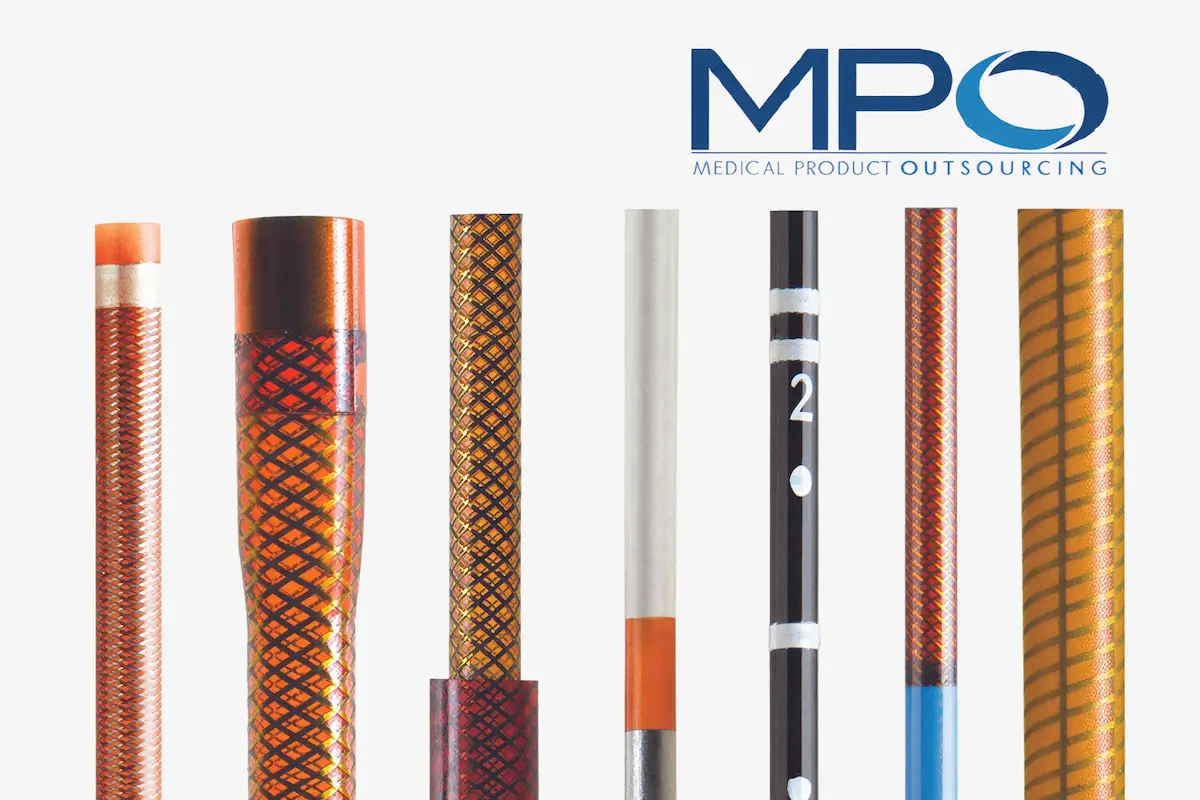
What OEM engineers quickly discover is that the differentiator among suppliers is not simply whether braid or coil options exist, but whether those reinforcements can be precisely controlled. Variables like braid density, wire type, coil pitch, transition placement, and bonding interfaces all influence final device mechanics.
At MicroLumen, we work closely with customers to tune reinforcement parameters so the shaft delivers predictable and repeatable mechanical behavior.
MDB: What should OEM engineers look for in composite tubing that combines PTFE and polyimide?
Fuller: Composite tubing has become increasingly important in minimally invasive devices because many systems require multiple performance properties that cannot be achieved with a single polymer.
A common example is the combination of PTFE and polyimide. PTFE provides extremely low friction, which supports smooth device passage and component delivery through the lumen. Polyimide, meanwhile, contributes high strength, dimensional stability, and structural integrity.
The challenge is that PTFE and polyimide are fundamentally dissimilar materials, and achieving a reliable bond between them requires significant process expertise. Few suppliers can integrate PTFE liners or polyimide tubing into a cohesive composite structure that maintains adhesion and performance under real-world loading conditions.
MDB: How does laser machining capability influence supplier selection?
Fuller: Laser machining has become a major enabling technology for catheter innovation, because it allows engineers to incorporate highly customized features directly into tubing structures.
These features may include micro-holes, flexibility-enhancing slot patterns, bonding transitions, or complex cut geometries designed to improve steerability and distal responsiveness. In many cases, laser machining is what makes multi-zone catheter architectures possible.
MDB: What criteria should OEM engineers use when selecting materials for minimally invasive device tubing?
Fuller: Material selection for minimally invasive device tubing is rarely based on a single property. Engineers must balance a wide range of mechanical and environmental requirements, including stiffness versus flexibility, torque transmission, pushability, lubricity, chemical exposure, thermal conditions, and wall thickness constraints.
OEM engineers should look for suppliers who can not only provide individual tubing components, but also engineer complete tubing systems that combine reinforcement, composites, machining, and bonding compatibility in a controlled and predictable way. MicroLumen’s strength is in supporting these complex, multi-zone catheter architectures. By offering precision polyimide tubing, reinforced shafts, PTFE composites, and integrated laser machining, we help OEM teams develop advanced minimally invasive devices with confidence in both performance and manufacturability.
For more information, visit www.microlumen.com.


Ready to engineer your solution?
Let's discuss how custom tubing can advance your next generation device.